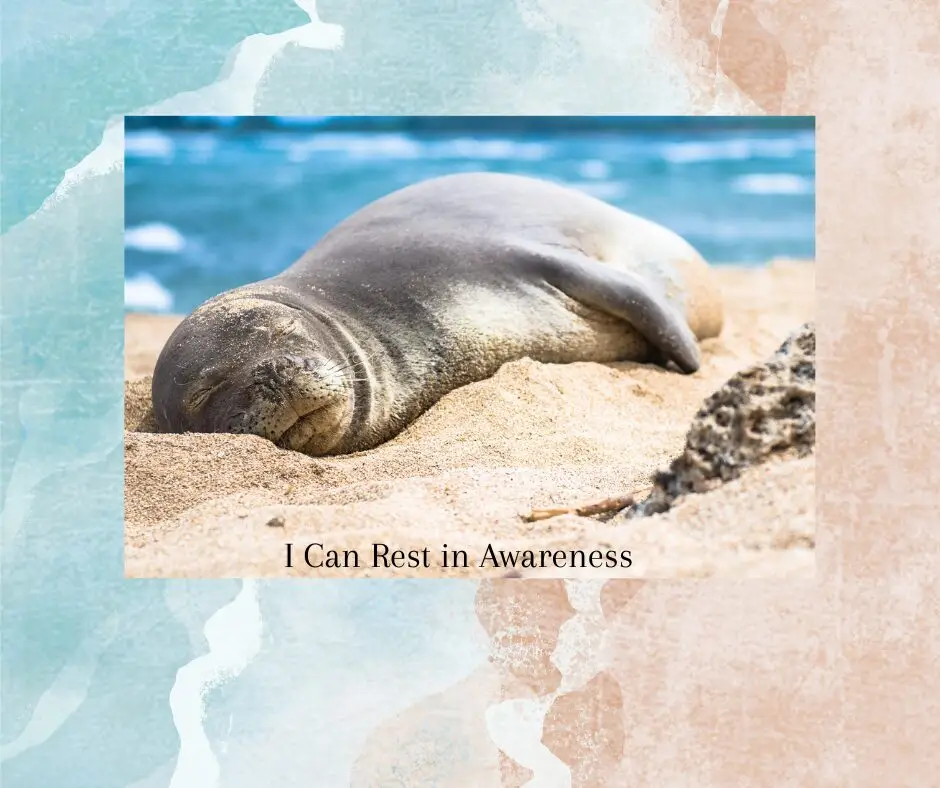
Awareness is often misunderstood as something we do—another task to master, another skill to perfect. But in Buddhist psychology, awareness is actually a place of rest. A safe harbor. A steady shoreline when the mind is busy throwing waves. It’s where you land when you stop chasing, fixing, analyzing, and arguing with your thoughts. Awareness isn’t effortful—it’s what remains when you stop fighting what’s already here.
Buddhist psychology offers a different way to relate to our thoughts—one that gently (and sometimes sassily) reveals how we may be unknowingly contributing to our own suffering. Over two thousand years ago, the Buddha identified a path toward reducing suffering, and one of his central insights was simple: the more clearly we understand what’s happening in our minds, the less we suffer because of it.
So what’s actually happening in our mental space? Buddhism considers the mind to be one of the senses—right alongside sight, sound, taste, touch, and smell. Thoughts are treated as sensory events. They arise, they pass, and they do not require our participation. Just as we don’t cling to a sound we hear or a scent we smell, we’re not meant to grip our thoughts like they’re urgent instructions.
From this perspective, thoughts are no more meaningful than the sound of waves, the warmth of sunlight, or the taste of ice cream. Yes—even that thought. Especially that one. They are fleeting experiences, not facts, not prophecies, and not definitions of who we are. Which is why a mantra like “Thought ≠ fact. Fuck off.” can be surprisingly grounding.
Awareness allows thoughts to exist without becoming emergencies. This is crucial—because when we catastrophize, it isn’t just “in our head.” A single thought can set off the body’s fight-or-flight system. The nervous system hears a scary story and immediately pulls the alarm, flooding the body with urgency, tension, and fear—even when there is no actual threat. The body reacts as if danger is present, simply because a thought appeared.
And here’s the important part: we know that most thoughts are distorted, exaggerated, or flat-out wrong. Yet the nervous system doesn’t fact-check—it reacts. Awareness is how we interrupt that cycle. When we step into observation instead of engagement, we send a different signal to the body: nothing needs to be solved right now. That’s how awareness helps settle the nervous system rather than fuel it.
This is where witnessing becomes powerful. Instead of reacting, we can rest back and choose distance:
- “Observe. Don’t engage.”
- “I can watch this thought without engaging in its drama.”
- “I’m not taking advice from a nervous system.”
Awareness lets thoughts pass without turning into full-body alarms. Like any sensory experience, they can be noticed and allowed to move on. Like a sound or a breeze, this will move on. You don’t have to push the thought away—or follow it down the rabbit hole. You can let it be there while resting in the part of you that is steady, grounded, and not in danger.
Of course, this isn’t easy—especially mid–thought spiral, when the mind is loud and the nervous system is convinced it’s a five-alarm fire. That’s why practice matters. Learning to rest in awareness when things are calm makes it accessible when things are not. Over time, you begin to recognize awareness itself as the refuge. You don’t have to argue with your thoughts or prove them wrong. You can simply land in the reminder: I can rest in awareness. And from there, move through everyday life without letting every catastrophic thought hijack your body and run the show.